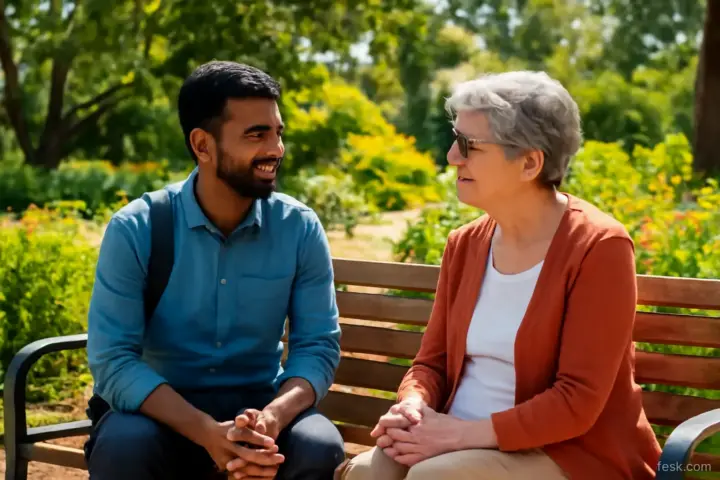

At a family gathering, an uncle asks, “So what’s your PhD about?” The doctoral student replies, “I study the effects of drought-induced leaf morphological changes on water-use efficiency in selected rice cultivars.” Everyone nods, goes quiet, and the conversation moves on. A year later she answers differently: “I’m working out why some rice varieties cope with drought better than others, so breeders can pick the right ones for dry regions. It turns out part of the secret is the shape of the leaf.” This time her uncle asks another question.
Explaining your thesis to a non-specialist in a few minutes is not “dumbing it down”. It is an exercise in choosing what matters most and saying it accurately in plain words. And, as many doctoral students discover, doing it well clarifies the project for them too.
A four-step structure
- A problem anyone understands: start from something the listener already knows or has experienced. “In recent years, many rice-growing regions have run short of water in the dry season.”
- Your question: one sentence. “I’m finding out why some rice varieties handle drought better.”
- How you are answering it: describe concrete, picturable actions. “I grow ten varieties in a greenhouse, cut their water and measure how every leaf changes.”
- What difference it makes: who benefits and how. “If we know which traits help plants survive drought, breeders can look for those traits earlier.”
If you have results, add one sentence between steps three and four: what you found, with at most one number.
Replace jargon with what it does
| Term | How to say it to a non-specialist |
|---|---|
| Water-use efficiency | How much grain a plant produces from the same amount of water |
| Educational intervention | A new way of teaching we tried out in classrooms |
| Multilevel regression model | A way of comparing pupils that allows for the fact that they attend different schools |
| Gene expression | Which genes are “switched on” to make proteins |
| Catalyst | A substance that speeds up a reaction without being used up itself |
The rule: in three minutes, keep at most one technical term, the one without which the listener would lose the main point, and explain it the first time it appears.
Analogies: powerful but easy to get wrong
A good analogy helps people see the invisible. A bad one leaves them with a misconception that lasts. Three conditions:
- It must be right on the point you need. Saying leaves have tiny “pores” that open and close to save water captures the idea; saying leaves “breathe” like people invites misunderstanding.
- Say where it stops working, when needed: “a bit like…, although the reality is more complex”.
- Use one main analogy. Three stacked analogies leave listeners lost.
Three lengths, three versions
| Length | Use it for | Contains |
|---|---|---|
| 30 seconds | Dinners, lifts, introductions at conferences | The problem and question, one line on why it matters |
| 3 minutes | Three Minute Thesis, meeting funders, interviews | All four steps, one result, one image |
| 10 minutes | School talks, community events, open days | The four steps plus one concrete story from the research process |
Write the three-minute version first. The thirty-second version is its opening; the ten-minute version is it plus a story.
The Three Minute Thesis competition
The Three Minute Thesis format began at a university in Australia and is now run at a great many institutions. Typical rules are three minutes, a single static slide, no props and no audio or video, presented to judges and a non-specialist audience. Each host sets its own rules, so read your institution’s call carefully. Judges usually assess two things: whether the audience understood and cared, and whether the talk conveyed why the research matters.
Your single slide should be a memorable image, not a text summary. If the audience has to read your slide, they are not listening to you.
Common mistakes
- Opening with the full thesis title. It was written for examiners, not for a general audience.
- Recounting the history of the field. Listeners do not need to know who did what in which year to understand your problem.
- Too many numbers. One well-explained number sticks better than five read in a row.
- Overpromising. “This research will solve water shortages” overstates it. “It will help choose suitable varieties” is accurate.
In practice: one week of rehearsal
- Day 1: write a three-minute version following the four steps, roughly 400 words.
- Day 2: strike every technical term and replace it with what it does, keeping one at most.
- Day 3: explain it to someone outside your field and ask them to retell it in their own words. Note where they get it wrong.
- Day 4: fix those points; ask someone in your field to listen and check you have not oversimplified into error.
- Day 5: record yourself, listen back and cut unnecessary sentences. Extract the thirty-second version from the opening.
- Days 6 to 7: say it several times without notes, remembering the four steps rather than memorising every word.
Next time someone asks what your research is about, try the thirty-second version and notice whether they ask a follow-up question. If they do, you have achieved something your twenty-page proposal never could.
Câu hỏi thường gặp
What is the Three Minute Thesis competition?
It is a competition in which doctoral students present their research in three minutes to a general audience, usually with a single static slide. It began at a university in Australia and is now run at institutions worldwide; specific rules are set by each host.
How do I explain jargon without being inaccurate?
Replace the term with what it does or what follows from it, and keep only the one essential term if needed, with a one-sentence explanation. Have someone in your field listen to check you have not simplified to the point of being wrong.
Should I use analogies to explain my research?
Yes, if the analogy is right on the point you need and you say where it stops working. A misleading analogy stays in people’s minds longer than no explanation at all.
What should I say if I do not have results yet?
Talk about the question, why it matters and how you will find the answer. General audiences care more about the problem and the approach than the final numbers.
Who should I practise explaining my thesis with?
Someone smart who is not in your field, such as friends from other disciplines or family members. Ask them to explain it back in their own words; wherever they get it wrong is where you need to fix your version.