
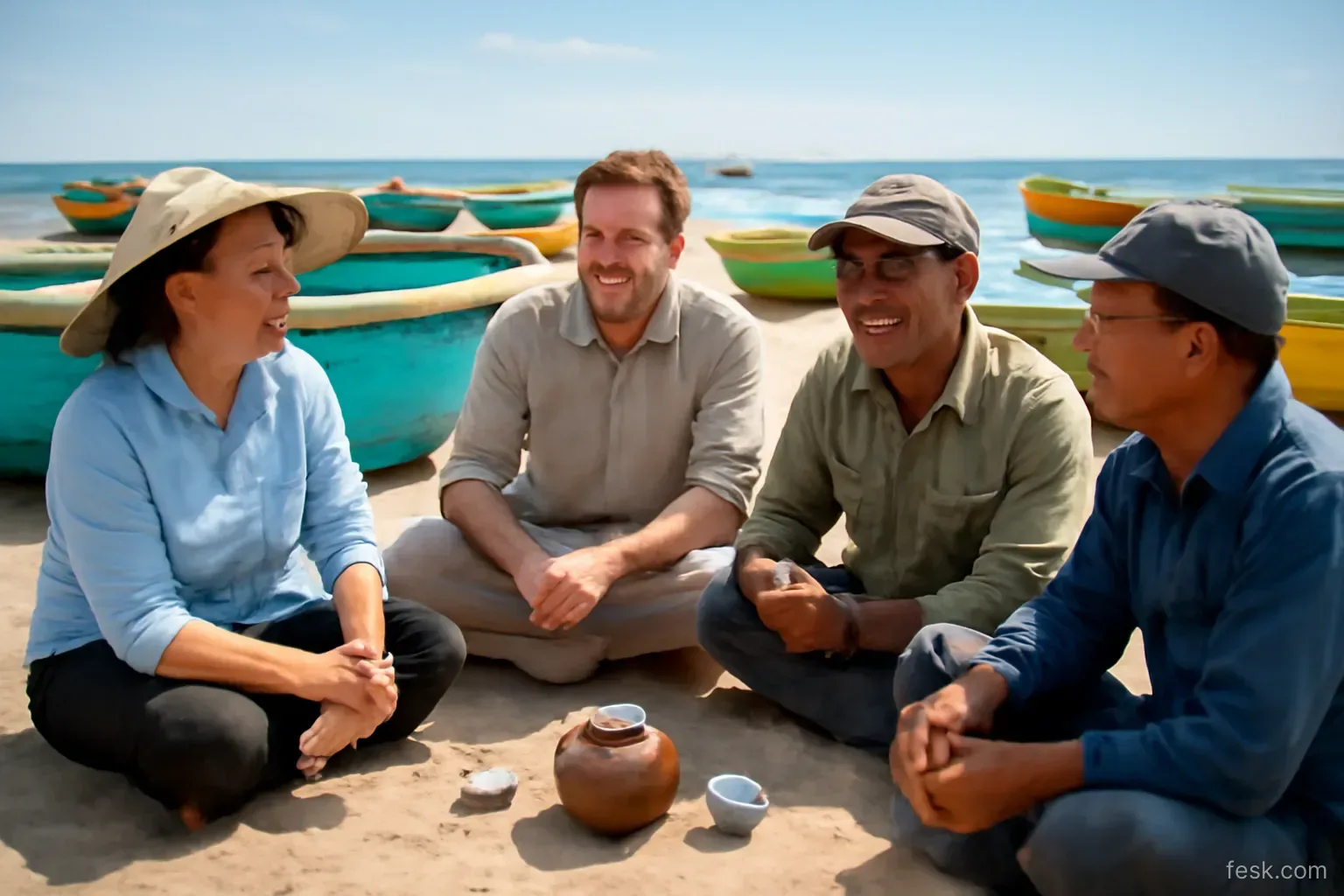
A team from a foreign university spends two weeks in a coastal province sampling water and interviewing fishers. A researcher at the local institute arranges permits, liaises with village officials, hires boats, interprets interviews and posts samples after the team flies home. Two years later the paper appears in a prestigious journal with eight authors, all based abroad. The local researcher is thanked in the acknowledgements. The fishers never hear the results. This is textbook parachute research, sometimes called helicopter research.
It does not only happen between rich and poor countries. It happens between elite and less-resourced universities within one country, and between city-based teams and remote communities. This article is for both sides: those who arrive and those who host.
Recognising a lopsided collaboration
- The research question is decided entirely elsewhere; local partners are given “fieldwork.”
- Data and samples leave the site and nobody locally retains access.
- Local collaborators are not invited to read the manuscript and learn of publication online.
- Payment for local effort is far below its real value, or absent.
- Participating communities receive nothing back: no results, no information, no benefit.
Why this is an integrity issue, not just etiquette
Authorship reflects real contribution. Under the ICMJE criteria, someone who contributed substantially to data acquisition and had the chance to review, revise and approve the final manuscript qualifies as an author. Excluding them misrepresents who did the research. Local knowledge also shapes quality: understanding context, language, how to ask questions, how to interpret anomalies. Leaving local colleagues out of analysis often impoverishes the conclusions. Some journals now ask authors to explain the involvement of local researchers when a study is conducted in another country, and the TRUST Code for equitable research in resource-poor settings is widely used as a reference.
A fair division of roles
| Stage | Parachute model | Equitable model |
|---|---|---|
| Setting the question | Decided elsewhere | Defined jointly and linked to local needs |
| Funding | Fully controlled by the visiting team | Part of the budget managed by the local partner |
| Ethics | Approval only at the visiting institution | Approval at both sites, respecting host-country rules |
| Data and samples | Removed with no copy left behind | Agreed storage, copies and access rights locally |
| Analysis and writing | Done separately | Joint analysis; local colleagues read and revise drafts |
| Authorship | Local people in the acknowledgements | Authorship by contribution, including first or last positions where fitting |
| After publication | No follow-up | Results returned in a language and format the community can use |
A collaboration agreement, written before you travel
This does not need to be a long legal document. Two pages covering the following prevent most disputes:
- The research questions and each party’s expected contribution.
- Budget allocation, including payment for local staff and field assistants.
- Who holds raw data and samples, where copies are kept, and who may use them for future work.
- Authorship principles and expected author order for planned papers.
- A deadline for circulating drafts to all co-authors before submission.
- A plan for returning results to the community and local authorities.
For biological samples, genetic resources or traditional knowledge, access and benefit-sharing rules may also apply. Check with the relevant authorities before any material leaves the collection site.
If you are the local partner
You are entitled to set conditions, and the best time is at the start, while your work is still what the other team needs:
- Propose a written agreement like the one above before applying for permits or collecting data.
- Ask directly: “Which parts of the analysis and writing will I lead so that I qualify as an author?” Then do them.
- Keep copies of the raw data and field notes.
- Propose a separate paper that you lead, using part of the data to address a locally relevant question.
Returning results to communities
Fishers, teachers and parents who take part in research rarely read English-language journal articles. Practical ways to give results back include a two-page summary in the local language, a short presentation at a community hall or school, or a report to the local agency that helped. It usually takes a few days, yet it decides whether you will be welcome next time, and it may reveal where you misunderstood the context.
A final check before submission
- Has everyone who contributed substantially been offered authorship?
- Have all co-authors read and approved the final version?
- Does the methods section report ethics approval and permits in the host country?
- Do the acknowledgements name field assistants, interpreters and communities correctly, where they agreed to be named?
- Does the plan for returning results have an actual date?
If you are preparing fieldwork somewhere else, the most useful step this week is to send a two-page draft agreement to your local partner and ask what they would change. Their answer will teach you more than any plan drawn up at a desk.
Câu hỏi thường gặp
What is parachute or helicopter research?
It is when researchers from elsewhere collect data and leave without meaningfully involving local collaborators in design, analysis or authorship, and without returning results to the community.
Should local collaborators be listed as co-authors?
Yes, if they contributed substantially, for example to data collection and interpretation, and had the chance to review and approve the final manuscript. Putting them only in the acknowledgements then misrepresents their contribution.
What should an international research collaboration agreement include?
Research questions, each party’s contribution, budget allocation, rights over data and samples, authorship principles, deadlines for reviewing drafts and a plan for returning results to the community.
What do I need to consider before taking research samples abroad?
Check access and benefit-sharing rules and export permits with the relevant authorities, and agree where samples will be stored and what copies or access the local partner keeps.
How can researchers return results to study communities?
Use formats people can access, such as a short summary in the local language, a community presentation or a report to local agencies. Plan this from the outset rather than as an afterthought.