
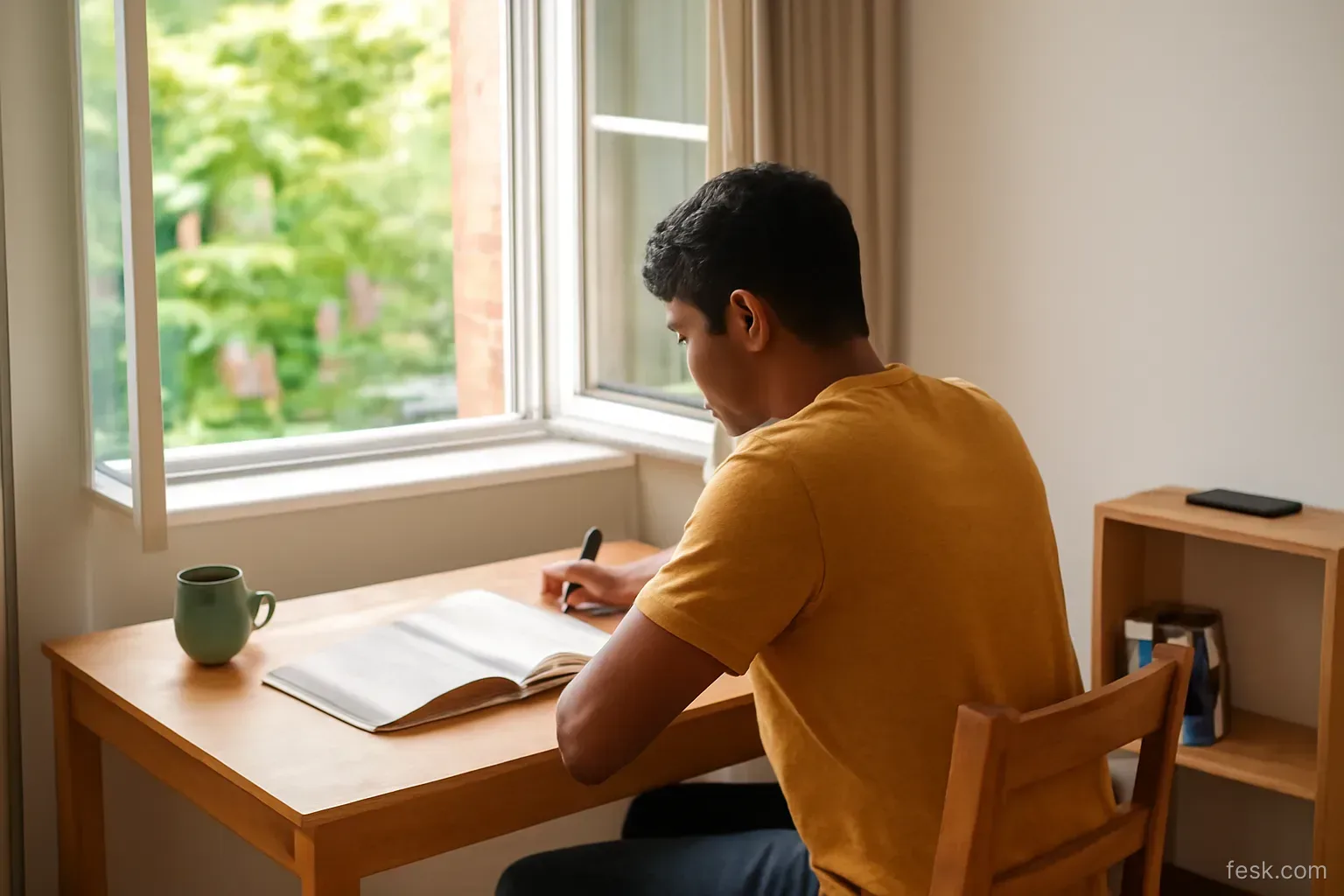
Many students measure study by hours at the desk. Four hours in the library sounds diligent, but if you glance at your phone every ten minutes, answer a message, open a tab to “quickly check” something and drift into a video, the time spent actually thinking about the work may be under an hour. The rest is time spent getting back to where you were.
Deep focus is not an inborn talent. It is the result of a designed session: a clear goal, an environment with few lures, and a plan for the moments you get pulled away. What follows is a concrete design.
The real cost of a quick glance
When you switch from task A to task B and back, part of your attention stays stuck on B. Researchers call this attention residue. You read a message in ten seconds, but its content lingers for minutes. If the message needs a reply you have not sent, the residue lasts even longer.
For easy tasks the cost is small. For work that requires holding many things in mind, like following a long proof, building an argument or debugging code, every interruption means rebuilding the whole chain. That is why one uninterrupted hour achieves far more than four fifteen-minute fragments.
A face-down phone is still a distraction
Many people assume that silencing the phone and turning it over is enough. But an object you know holds messages, feeds and email keeps a slice of your attention: you know it is there and that something new might be waiting. The most reliable fix is almost embarrassingly simple: put the phone in another room, or zipped inside a bag, out of sight.
If you use your phone as a timer, get a cheap kitchen timer or a watch. If you need your laptop, close unrelated tabs, switch off system notifications and consider a website blocker for your study hours.
A 90-minute session blueprint
| Time | Activity | Purpose |
|---|---|---|
| 5 minutes before | Write the output goal, clear the desk, remove the phone | Know exactly what you are doing |
| 0–45 min | First work block | Get deep into the problem |
| 45–55 min | Break: stand, drink water, look into the distance, no screens | Recover without creating new residue |
| 55–85 min | Second work block | Continue or move to the next part |
| 85–90 min | Note where you stopped and the very next step | Start instantly next time |
Two details matter most. The break is screen-free, because scrolling during a break creates exactly the residue you are trying to avoid. And the last five minutes spent recording your stopping point save the twenty minutes you would otherwise spend finding your thread next time.
Output goals instead of time goals
“Study chemistry for two hours” is a time goal: you can meet it without learning anything. “Balance six redox equations and write down the two mistakes I keep making” is an output goal: at the end you know whether you are done. A good output goal has three features:
- Checkable: it produces something concrete, such as a number of problems, a page of draft, a redrawn diagram.
- Sized for one session: if you never finish, the goal is too big.
- Starts with a doing verb: solve, write, redraw, summarise, self-test, never “look at” or “go over”.
Handling stray thoughts
Midway through, your mind will remind you to reply to your supervisor, buy groceries, check another deadline. Pushing the thought away only brings it back. A better approach: keep a “later” sheet beside you. When a thought arrives, write one line and return to work. Writing it down reassures your brain that it will not be forgotten.
Do the same with the urge to look something up, unless it genuinely blocks the task. The “quick search” is one of the most common doors out of focus.
A word on Pomodoro
Twenty-five minutes on, five minutes off is popular and genuinely useful for getting started when you are procrastinating. But for work that needs depth, such as essay writing or long problems, twenty-five minutes is often just long enough to get into the flow before the bell rings. There is no magic number. Try 25, 45 and 60-minute blocks and pick the length at which you are usually still engaged when time is up. Pomodoro is a starter motor, not a rule.
Match the place to the task
- Deep thinking (proofs, arguments): somewhere quiet with little foot traffic and no music with lyrics.
- Routine, low-demand work (formatting, data entry): a café or background music is fine.
- Use one fixed spot for deep work: over time, simply sitting there becomes a cue to begin.
If you share a busy home, a university library, a bookable study room or an early-morning slot is often worth more than trying to concentrate in a noisy shared space.
Things you do not need
- Four straight hours. Two high-quality 90-minute sessions beat one long, fragmented day.
- A perfect environment. Just remove the biggest lures: the phone and social media tabs.
- Self-blame when you drift. Notice, write it on the “later” sheet, return. The returning is the skill you are training.
In your next session, change just one thing: leave your phone in another room and write an output goal at the top of the page. At the end, compare what you produced with what you planned. After five sessions you will know which block length suits you and how much real work a session holds.
Câu hỏi thường gặp
How can I focus on studying for longer?
Set a concrete output goal for each session, keep your phone out of sight, and work in 45 to 60-minute blocks with screen-free breaks. Focus comes more from session design than from willpower.
Is putting my phone face down enough to avoid distraction?
Usually not. Knowing the phone is right beside you still draws on your attention. Leaving it in another room or inside a zipped bag works much better.
Does the Pomodoro technique work?
It helps you start when you are procrastinating and suits short tasks. For deep work, 25 minutes can be too short, so try 45 or 60-minute blocks.
What should I do during study breaks?
Stand up, move, drink water and look into the distance, avoiding screens. Scrolling during breaks leaves attention residue that makes it harder to return to work.
What do I do when I remember other tasks while studying?
Keep a “later” sheet and write the thought down in one line, then go back to work. Writing it down reassures your mind and protects your train of thought.