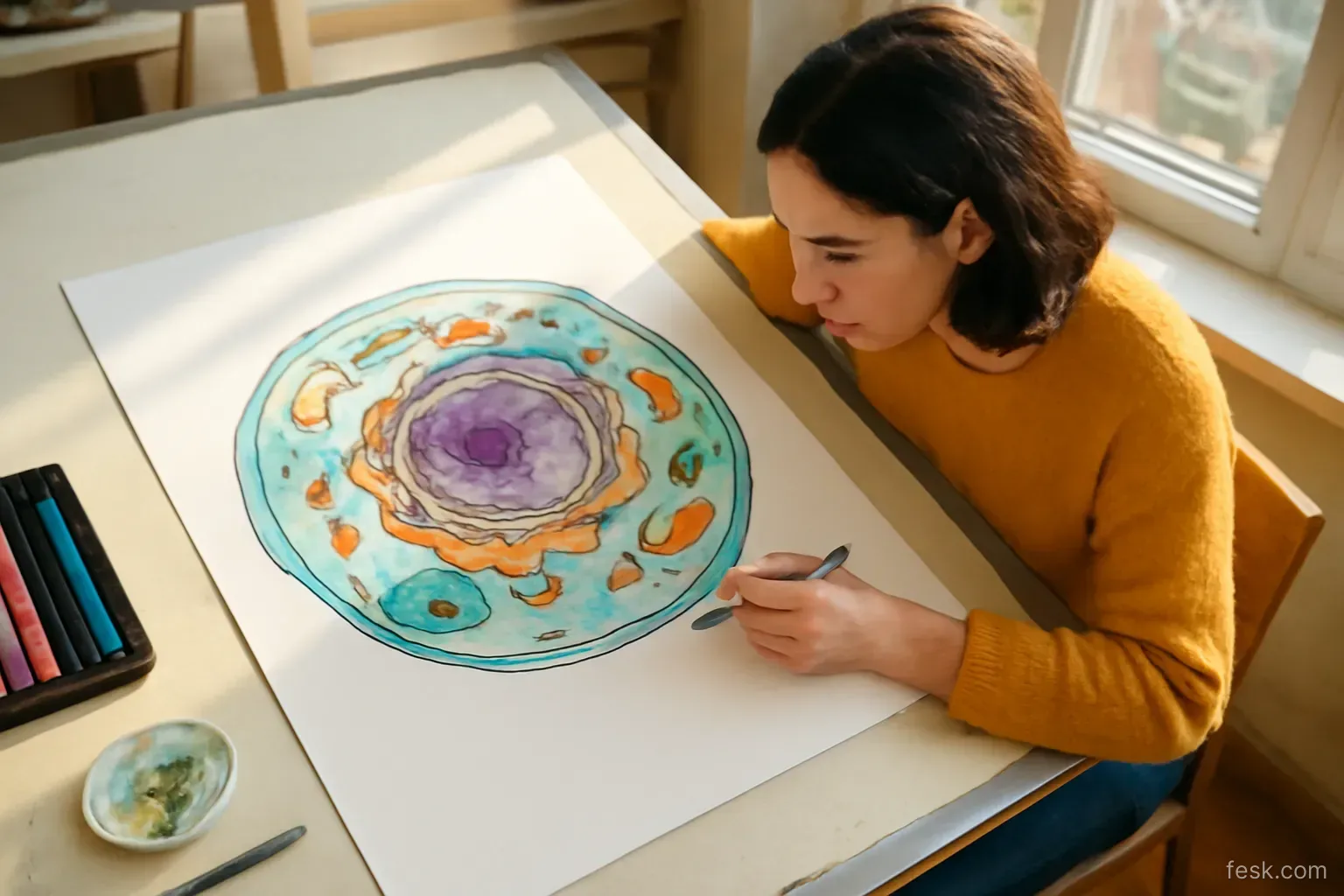
A research team needs a mechanism illustration for a review paper. Nobody can draw, and commissioning an illustrator would take too long. One member uses an AI image generator and gets an attractive, harmoniously coloured figure within minutes. Nobody notices that a cellular structure is in the wrong place and the tiny labels are nonsense words. The editor does. The paper comes back with a request to replace the figure and explain, and the journal now has a question mark over the whole team’s reliability.
Images in scholarship are not decoration. They convey knowledge, and readers trust them to be accurate. AI image generators produce figures that look right, not figures that are right, which is why the rules for them are stricter than the rules for text.
Three kinds of image, three levels of risk
| Image type | Examples | Common position |
|---|---|---|
| Images that show data or results | Micrographs, gels, field photographs, results charts | Generative AI must not create or alter their content; doing so is falsification |
| Conceptual illustrations | Mechanism diagrams, graphical abstracts, cover art | Many journals prohibit them; some allow them with disclosure and clear usage rights |
| Images in talks and teaching | Slide backgrounds, scenario illustrations | More flexible, but still label them and never present them as real photographs |
Specific rules vary by publisher and change quickly. Before you use anything, read the AI section of your target journal’s author guidelines, even if you have published there before.
Why AI illustrations are riskier than they seem
- Plausible technical errors: wrong numbers of limbs, misplaced organelles, reversed flows, impossible chemical bonds. Outsiders miss them; specialists spot them instantly.
- Fake text: labels and annotations inside the image are often meaningless strings.
- Unclear copyright: the legal status of AI-generated images is still contested in many places, while journals need you to transfer or license rights to your figures.
- Hard to revise: when a reviewer asks you to change one detail, you cannot alter just that detail and keep the rest.
A grey zone: AI-based image processing
Many instruments and software packages now use machine learning to denoise, upscale or segment microscopy images. This is not prompt-based generation, but it still changes image data. General principles:
- State in the methods which software, model and parameters were applied to which images.
- Keep the unprocessed originals and be ready to supply them.
- Do not use upscaling to “reveal” fine detail and then analyse that detail as if the instrument had recorded it.
- Apply the same pipeline to every image you compare.
If your journal allows AI illustrations
Where they are permitted, typical conditions are:
- Disclose the tool in the figure legend and/or the methods.
- Make sure the tool’s terms allow commercial use and allow you to license the image to the publisher.
- Accept responsibility for the scientific accuracy of the figure.
Example legend note: “Figure 1 was initially generated with an AI image tool [name, version] and edited and checked for accuracy by the authors. Labels were added manually.”
Safer options if you cannot draw
For diagrams in papers, lower-risk routes include:
- Drawing in vector graphics software or even presentation software with simple shapes. A simple, correct diagram beats a beautiful, wrong one.
- Using scientific icon libraries with clear licences and attributing them as the licence requires.
- Sketching by hand and asking someone with design skills to finish it, credited in the acknowledgements.
- Using AI only to suggest a layout (“how should I arrange these five components for readability?”) and drawing the final figure yourself.
Posters, slides and lectures
Conferences and classrooms are usually more relaxed, but a few principles still apply:
- Do not use photorealistic AI images to illustrate real data or real events (a “field photo,” for example).
- Add a small “AI-generated illustration” note on the image or on a sources slide.
- In teaching, consider turning AI images into material: asking students to find the technical errors in an AI-generated diagram is a very effective exercise.
When a co-author has already used one
In large teams, one person often makes the figures and nobody else asks where they came from. Make “how was this image made?” a line in your pre-submission checklist for every figure. If you discover an AI-generated image in a published paper at a journal that prohibits them, contact the editor and propose a replacement figure and a correction. Reporting it yourself is always better than having a reader find it.
A checklist before a figure goes in
- Does this image show data or illustrate a concept?
- What does the target journal say about AI-generated or AI-altered images?
- Has a specialist checked every detail?
- Is there any machine-generated text or labelling, and has it been replaced with typed labels?
- Do the tool’s terms let you license the image to the publisher?
- Is the use disclosed in the legend and methods?
If you are preparing figures for a paper, open your target journal’s author guidelines today and search for “AI” or “image.” Those five minutes decide whether you spend the afternoon generating a figure or redrawing it.
Câu hỏi thường gặp
Can I use AI-generated images in a scientific paper?
Images that show data almost never. Conceptual illustrations depend on the journal: many prohibit them, some allow them with disclosure, clear usage rights and author responsibility for accuracy.
Do I need to disclose AI denoising of microscopy images?
Yes. Report the software, model and parameters in the methods, keep the original images and apply the same processing to all images being compared.
Are AI-generated images copyrighted?
Their legal status is still unsettled in many jurisdictions, while journals need you to license figures to them. Read the tool’s terms and the publisher’s policy before using one.
Can I use AI images on a conference poster?
Usually yes, with more flexibility, but label them as AI-generated and never use photorealistic images to depict real data or events.
How can I make diagrams for a paper if I cannot draw?
Use vector or presentation software with simple shapes, licensed scientific icon libraries, or help from someone with design skills. A simple, correct diagram beats an attractive, wrong one.