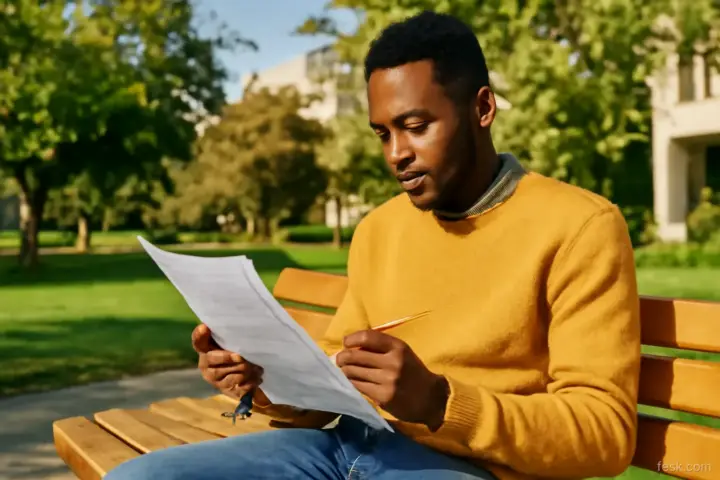
A third-year student writes an English essay by hand over two weeks. An AI detector labels it “likely AI-generated”. She used no AI assistant at all, but she wrote exactly as she had been taught: short sentences, clear structure, standard linking phrases, few idioms. Her careful second-language style was precisely what the tool was looking for.
AI detectors are increasingly common in education. Understanding what they measure, and what they cannot, matters for anyone who is flagged and anyone reading the results.
What AI detectors measure
Most tools rely on statistical features of text. Two terms come up often:
- Perplexity: text in which a language model can easily predict the next word is treated as “machine-like”.
- Burstiness: human writing tends to mix long and short sentences irregularly; machine text is more uniform.
Other tools are classifiers trained on human and machine text. Either way the output is a probability, not a finding. The tool does not see AI in the text; it estimates how closely the text resembles machine output.
Why false positives happen
| Situation | Why it gets flagged |
|---|---|
| Second-language writers | Narrower vocabulary and safe, predictable structures; independent research has found higher false-positive rates for this group |
| Formulaic genres | Methods sections, abstracts and lab reports follow fixed templates |
| Short texts | Too little text for statistics to mean much |
| Grammar-checked writing | Smoothed sentences reduce variability |
| Classic or textbook phrasing | Models have seen these sentences countless times |
The reverse is also true: AI-generated text that has been lightly rewritten often slips through. So detectors both wrongly flag honest writers and miss dishonest ones. Many universities now advise against using a detector score as the sole basis for a misconduct finding.
If you are a student who has been flagged
- Stay calm and delete nothing. Drafts, version history and notes are your evidence.
- Ask what the concern is based on: only the detector score, or other signs such as non-existent references, off-topic content or a style very different from your earlier work?
- Gather process evidence: version history from your online document, dated file saves, outlines, reading notes, photos of handwritten drafts, your literature search history.
- Ask for a conversation. Be ready to explain your argument, why you chose your sources and how you reached your conclusions. People who wrote their own work can usually talk about it fluently.
- Explain relevant context: if you write in a second language or used a permitted grammar tool, say so.
- Learn the appeal process and your rights, such as bringing a support person to meetings.
Keep your tone calm and factual. Angry protest letters rarely help.
If you are a teacher looking at a flag
- Treat the score as a reason to look more closely, not as a conclusion.
- Look for verifiable signs: references that do not exist, generic content unconnected to course materials, a large gap from the same student's in-class writing.
- Talk to the student before concluding anything, asking about their process and the content. The aim is to understand, not to trap.
- Consider groups prone to false positives: second-language writers deserve particular care.
- Follow your institution's procedure and document each step.
What a fair meeting looks like
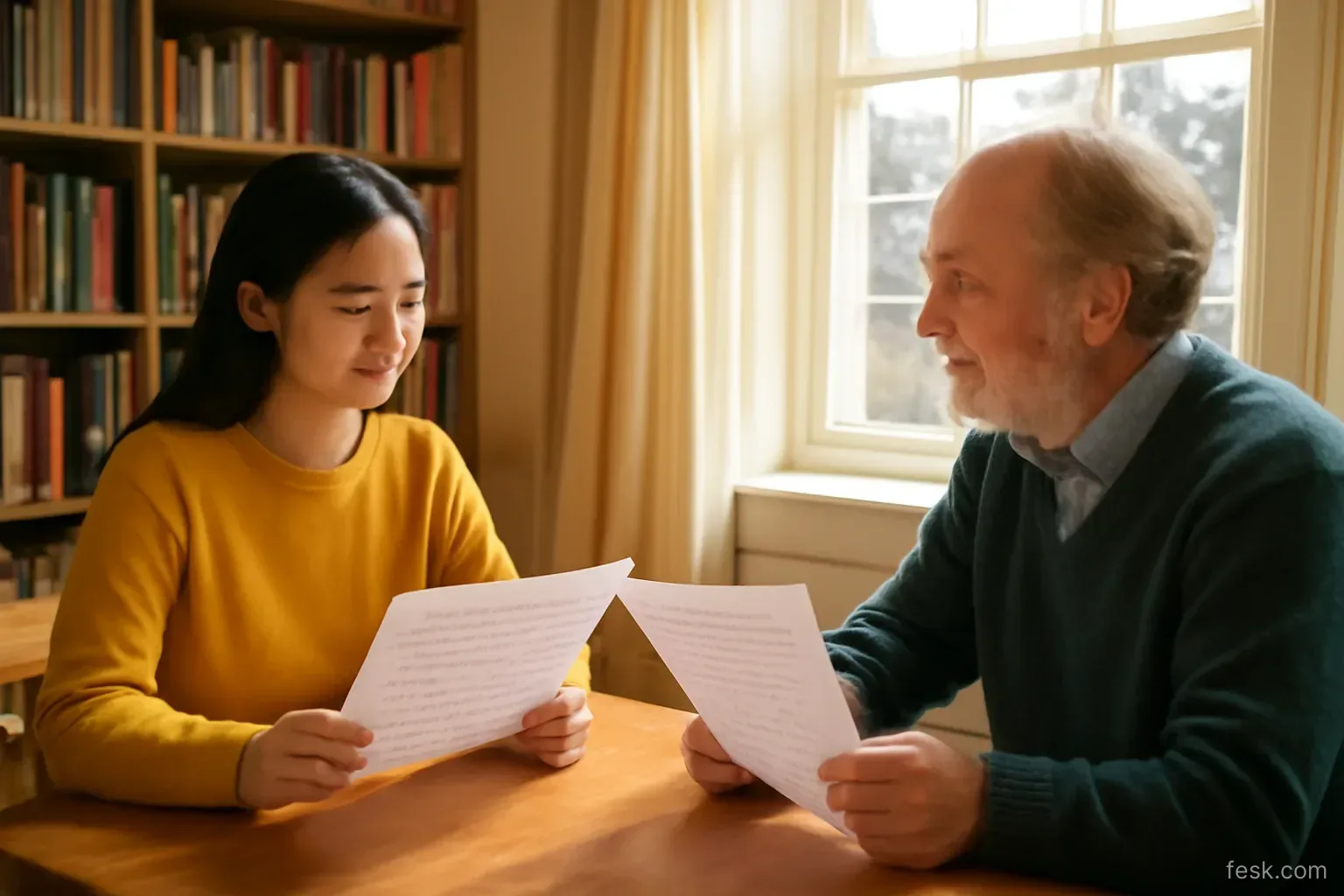
A good meeting resembles a short viva more than an interrogation. Typical questions, which are also worth rehearsing yourself:
- “Where did you start with this essay? What did your first outline look like?”
- “Why did you choose this source over others?”
- “What is the basis for the argument in your third paragraph? How would you respond to someone who disagreed?”
- “Which part did you find hardest to write?”
People who wrote their own work usually answer with concrete detail, including dead ends they abandoned. For their part, teachers should keep a written record, share it with the student for confirmation, and separate what has been verified from what is merely suspected.
Prevention: habits that give you peace of mind
For students and researchers, the best protection is not trying to fool the tool but having process evidence ready:
- Write on a platform with automatic version history.
- Keep outlines and early drafts, even the ugly ones.
- If you use AI in permitted ways, log it and disclose as required.
- Keep dated reading notes.
Avoid “humaniser” tools that rewrite text to evade detection. They often make prose awkward, can change meaning, and using them invites suspicion in its own right.
The right way to think about detectors
An AI detector is like an inaccurate scale: it can suggest that something deserves a second look, but nobody should be penalised on the strength of its reading alone. Real evidence of authorship lives in the process: drafts, revision history, and the writer's ability to explain their own work.
Something to do today: if you are working on an important piece, move it to a platform with version history and save your current outline. If the work is ever questioned, you will have an answer in minutes rather than weeks.
Câu hỏi thường gặp
Are AI detectors accurate?
Not accurate enough to be used alone. They produce probabilities based on statistical features, can flag human writing as AI and can miss AI text that has been edited.
Why was my own writing flagged as AI-generated?
Uniform style, safe sentence structures, short or formulaic texts are all prone to being flagged. Second-language writers are especially likely to receive false positives.
What should I do if I'm accused of using AI?
Collect version history, drafts, outlines and reading notes, and be ready to explain your argument. Ask what the concern is based on and how the appeal process works.
Can a teacher find me guilty based only on an AI detector?
It is widely discouraged. Many institutions advise against relying on detector scores alone and expect verifiable evidence plus a conversation with the student.
Should I use an AI humaniser to avoid being flagged?
No. These tools can distort meaning and make writing awkward, and using them looks suspicious in itself. Evidence of your writing process is the best protection.